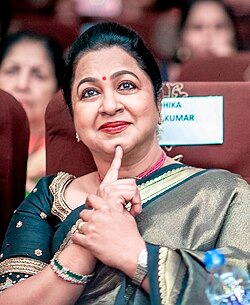
Radhika Sarathkumar
Fellow fans ✨
Biography
Early Promise: Roots of a Performer
Born on 21 August 1962, Radhika Sarathkumar emerged into an Indian film world that in the 1970s and 1980s was rapidly evolving. From the earliest accounts of her career, she showed a combination of poise and intensity that marked her as more than a fleeting presence on screen. While the precise contours of her childhood and first steps into acting vary across recollections, what is consistent is that she found an early foothold in regional cinema — primarily in Tamil and Telugu films — at a moment when South Indian cinema was producing a new generation of performers capable of carrying both commercial fare and emotionally rigorous dramas.
Breaking Through: The Rise to Stardom
The arc of Radhika’s early career is defined by a sequence of steady, character-driven choices that led to wider recognition. Throughout the 1980s and into the early 1990s she oscillated between lead roles in mainstream films and intense, dramatic parts that tested her range. Directors and casting agents began to notice a performer who could deliver vulnerability and steel in equal measure. Those early collaborations — with directors who were experimenting with narratives that foregrounded complex women and with co-stars who demanded a strong screen partner — established Radhika as a dependable leading lady.
Her breakthrough was not a single overnight phenomenon but rather the accumulation of performances that made her name synonymous with credibility. Film critics of the period pointed to her capacity to disappear into roles, and audiences responded to her emotional honesty. By the late 1980s she was a familiar face across South Indian cinema, one who could anchor both family dramas and more gritty, issue-based films.
"Acting, for her, was never about glamour alone but about telling human stories that held up a mirror to audiences."
At the Summit: Peak Years and Major Achievements
As the 1990s unfolded, Radhika entered what many observers would call her peak period. She delivered a series of performances that consolidated her status as a major actress in Tamil and Telugu films, winning both popular and critical acclaim. Her name began appearing in conversations about awards and end-of-year best-of lists; she accumulated several honors from state award bodies and the South Indian film fraternity, reflecting her broad appeal.
At the same time, Radhika expanded the definition of her career beyond acting. She became one of the early actresses to move decisively into production and content creation for television, sensing the medium’s potential to reach millions of homes. This entrepreneurial step would prove pivotal: it not only diversified her creative output but also made her one of the most influential figures in South Indian television. Her production house produced serials that resonated widely, reshaping daily viewing habits and setting new benchmarks for narrative and production values.
The Difficult Years: Setbacks and Challenges
No career that spans decades is without setbacks, and Radhika’s journey has had its share. The film industry’s shifting commercial landscape meant that some projects, even with her name attached, underperformed at the box office. As younger faces and changing audience tastes emerged, getting the right scripts and roles became an ongoing challenge. There were professional disappointments — films that failed to connect or that miscast the promise of a script — and the public scrutiny that accompanies high-profile artists occasionally intensified around choices she made, both on and off screen.
The growth of satellite television in India brought its own set of pressures: the creative and financial stakes of daily serials were high, and navigating production logistics while maintaining artistic standards was not always smooth. There were moments when productions stretched resources, relationships with collaborators were tested, and public controversies around casting or narrative choices required a steady hand.
Key Turning Points: Reinvention and Strategy
Radhika’s career is best understood through the turning points where strategic decisions altered her path. One of the most consequential was her early recognition of television as a space for long-form storytelling in which she could invest as both artist and producer. Establishing a strong production presence allowed her to influence content from the inside — choosing stories, developing scripts, and shaping the careers of younger actors. That strategic reinvention converted an actress with a string of notable film roles into a multi-hyphenate creative force in South Indian entertainment.
Another turning point arrived when she embraced character and matriarchal roles in cinema as she matured — a transition many film actresses find difficult in an industry often driven by youth. Rather than resist age-appropriate casting, Radhika retooled her screen persona, bringing the same intensity to supporting roles as she had to leads. This decision kept her visible to filmmakers and audiences and expanded the kinds of stories she could tell.
Handling Criticism and Career Slumps: Resilience in Practice
Radhika’s responses to criticism and downturns reveal the resilience that has sustained her. Public setbacks, whether a poorly received film or heated media coverage, were met with pragmatic choices: she returned to rigorous script selection, leaned on television projects to stabilize her creative output, and used production as a workshop for new talent and new ideas. In interviews and public appearances she has often emphasized craft and preparation, framing criticism as part of a larger, long-term career conversation rather than a terminal verdict.
On a practical level, she addressed slumps by broadening her professional activities — mentoring younger actors, producing serials that tapped into changing audience sensibilities, and taking on character roles in films that valued gravitas over glamour. These moves not only restored momentum but also demonstrated an adaptive intelligence: she reshaped her public image on her terms rather than allowing the industry to pigeonhole her.
Finding the Way Back: Comebacks and New Highs
Several projects in Radhika’s later career acted as comebacks, reaffirming her status as a formidable performer. Returning to film after successful runs in television, she chose roles that leveraged her maturity, emotional depth, and the authority she carried as both an actor and a producer. Films in the 2000s and 2010s cast her in powerful supporting parts — doctors, mothers, community figures — that were crucial to narrative stakes and showcased her ability to elevate ensemble acts.
On television, her productions continued to pull strong ratings and cultural attention, and she developed a reputation as someone who could launch enduring serials and steer complex productions. This dual visibility — in front of the camera and behind it — cemented her comeback not as a single film moment but as a sustained reassertion of relevance.
Legacy and Impact: The Continuing Journey
More than three decades after she first came to public attention, Radhika Sarathkumar stands as an emblematic figure in South Indian entertainment: an actress who transitioned seamlessly into production, a creative entrepreneur who reshaped television content, and a performer who adapted her craft to the rhythms of a changing industry. Her legacy is measured in multiple currencies — influential serials that defined viewing habits, memorable film performances that critics still cite, and a professional example for younger women in the industry who seek agency beyond acting alone.
Her career arc — from promising young actress to industry stalwart and creative executive — illustrates a core lesson of longevity in cinema: adaptability married to craft. Whether celebrated for early dramatic turns, for producing landmark serials, or for the dignified matriarchal roles that came later, Radhika’s story is one of continual reinvention. The industry she helped shape has changed profoundly, but her imprint on it remains visible in the actors she has mentored, the stories she has championed, and the viewers who grew up watching her work in multiple forms.
The Continuing Chapter
As contemporary filmmakers and showrunners look back on the past decades of South Indian cinema and television, Radhika’s career is often cited as a model of sustained relevance. She has navigated fame and criticism, success and setback, with a pragmatic creativity that allowed her to pivot without losing the core of her artistic identity. The chapters of her life that lie ahead — new productions, nuanced roles, perhaps even mentorship and institutional engagement — will likely continue the pattern she has established: a commitment to storytelling, an appetite for challenge, and a determination to remain both artist and architect in a creative world she helped make her own.
Personal Details
- Date of Birth
- August 21, 1962
- Nationality
- India
Recent Fans

Ramesh Hanumanthu
7 months ago