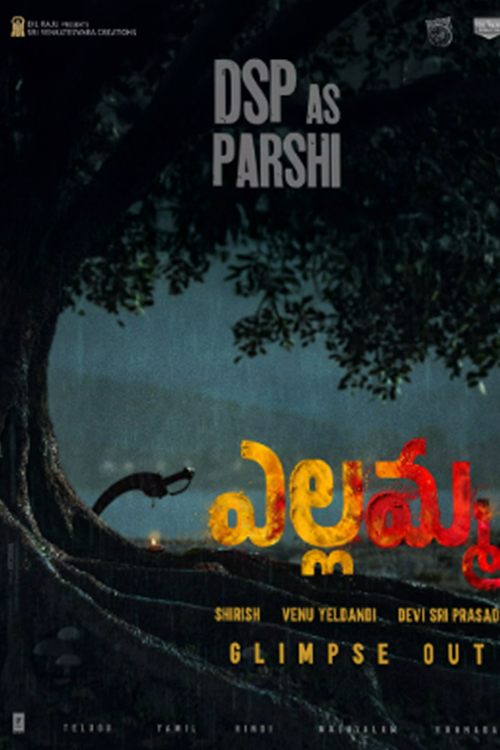
Yellamma
ఎల్లమ్మ
Synopsis
The Story Set in a contemporary riverside town straddling the languages and borders of South India, Yellamma follows a fiercely determined woman as she confronts an inherited system of ritual, power and silence. The film opens when Yellamma—a thirty-something schoolteacher who has spent years workin...
Storyline
The Story
Set in a contemporary riverside town straddling the languages and borders of South India, Yellamma follows a fiercely determined woman as she confronts an inherited system of ritual, power and silence. The film opens when Yellamma—a thirty-something schoolteacher who has spent years working in the city—returns to her ancestral village to care for her ailing mother, Padma. What appears at first to be a quiet homecoming quickly becomes the spark for a larger struggle when Yellamma discovers a stack of dusty ledgers and a set of ritual records tied to the village’s centuries-old temple of the goddess Yellamma.
Built around the collision between ancient faith and contemporary justice, the narrative positions its central conflict in the space where devotion has been converted into control. The village’s annual festival—an explosion of color, music and procession—provides the tonal anchor for the film. Its ebullient exterior conceals a ledger of human lives: girls and women who have historically been dedicated to the temple and then relegated to marginal lives, bound by custom and sanctioned by influential men who profit from the arrangement. Over the course of the film, Yellamma is drawn into exposing how religious authority, local politics and patriarchal economy intertwine to keep this system alive.
Characters and Relationships
At the center of the story is the titular protagonist, Yellamma, whose compassion, memory and moral clarity drive the narrative. She returns with the quiet confidence of someone who has known the city’s modern freedoms but also the acute pain of an unassuaged past. Her motivation is both filial—caring for Padma—and ethical: she cannot abide the idea that devotion is being used to justify exploitation.
Yellamma’s chief ally is Raghav, an earnest investigative journalist from the nearby city who sees the story as the one that could change his career and, more importantly, change lives. Initially an outsider to the village’s layered loyalties, Raghav must learn local histories and listen before acting, and this humbles him and deepens his commitment. Rekha, a childhood friend now positioned as a rising local politician, represents an ambiguous thread—at first investing in reform as a campaign vehicle, she must later choose between political expediency and moral courage.
The antagonistic forces are less a single person and more a network: Suresh, a powerful landowner and businessman, who benefits from the status quo; Pandit Basava, the temple’s priest whose faith is complicated by dependence on the temple’s social order; and the complicit silence of many village elders. Yellamma’s interactions with the community of women affected by the temple—older women hardened by survival, younger girls still shaping their identities—provide the emotional center. Their stories are intimate, personal and gradually woven into a collective voice that both haunts and empowers Yellamma’s campaign.
Story Structure and Key Events
The inciting incident comes when Padma, on her deathbed, urges Yellamma to look into the ledgers and to remember a promise she made years ago. What follows is a two-part investigation: one part legal and journalistic, as Raghav and Yellamma gather testimony and evidence; the other part cultural and personal, as Yellamma confronts childhood memories, forbidden friendships and the moral compromises made by people she loves.
Major plot points include the revelation of the temple’s ledger, a public hearing triggered by Rekha’s tentative support, and a violent crackdown when entrenched powers try to intimidate witnesses. Subplots—such as the rekindling of Yellamma’s friendship with Rekha, Basava’s crisis of faith, and Raghav’s struggle to reconcile his reportage with the community’s need for sensitivity—enrich the main narrative and illustrate how change entails both public truth-telling and private reconciliation.
The film’s climax unfolds during the temple’s grandest festival, when centuries of ritual spectacle and economic interest converge. In a charged public confrontation, Yellamma forces a communal reckoning that tests loyalties and exposes the human cost of sanctified silence. The resolution is deliberately measured: the film concludes with a community beginning the hard work of redefinition and repair—legal steps, grassroots support networks and the first public acknowledgements—while leaving enough ambiguity to acknowledge that deep structural change is gradual.
"We were named by the river; we will not be owned by a ledger."
Themes and Meaning
Yellamma is a meditation on the friction between tradition and justice, devotion and ownership. It examines how religious narratives can be weaponized to uphold social hierarchies and how courage often takes the form of asking uncomfortable questions in the face of communal piety. Central themes include female agency, collective memory, and the dynamics of power disguised as piety. The film probes the moral responsibility of communities to interrogate their rituals and the resilience required to reclaim dignity for the vulnerable.
The emotional core of the story is Yellamma’s personal journey from private pain to public leadership. Her arc is not about spectacular heroism but about the slow accrual of trust—learning to listen to other women’s stories, to transform grief into solidarity, and to translate personal truth into a platform for communal change. The film also explores the grey zones of complicity: characters like Basava and Rekha are neither purely villainous nor wholly heroic; their development reflects the film’s nuanced view that cultural transformation requires both confrontation and empathy.
Visual Style and Atmosphere
Visually, the film contrasts the luminous, frenetic energy of the village festival—brilliant saris, temple lamps, drumming and folk processions—with the quiet, intimate interiors where secrets are kept. Cinematography favors wide, pastoral frames of the river and paddy fields to evoke the regional rhythms of life, counterbalanced by tight close-ups that capture the small gestures of resilience: a hand steadying a lamp, an exchange of glances, a ledger opened to reveal names. Night sequences lit by oil lamps and float-like reflections on the river create a contemplative mood, while daytime festival scenes are choreographed as cinematic set pieces that are at once celebratory and ominous.
Sound design plays a central role: folk songs and devotional chants are woven into the score, sometimes as a chorus that comforts and at other times as a chorus that isolates. Technical achievements are subtle—a restrained use of long takes during testimony scenes to allow emotional beats to land, and a careful layering of crowd sound during confrontations to reflect the pressure of public scrutiny.
Conclusion
Yellamma is a powerful, humane film that blends social realism with lyrical storytelling. It refuses easy binaries, instead offering a portrait of a woman who becomes the catalyst for change not by overthrowing a system in a single act, but by illuminating its human costs and helping a community imagine a different future. The film’s impact lies in its empathetic attention to voices often left at the margins, and in its conviction that ritual and faith can be reclaimed in ways that honor dignity rather than diminish it. For audiences, Yellamma is both a demanding and deeply rewarding experience—an urgent cinematic conversation about faith, memory and the quiet courage of ordinary people.
Did You Know?
Trivia information coming soon.