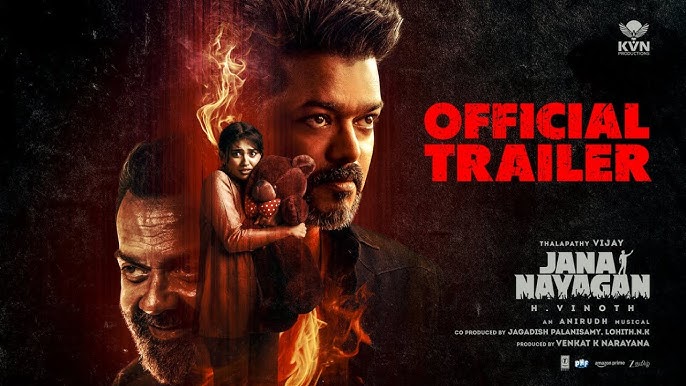
Vijay’s much-awaited Jana Nayagan was meant to roar into theatres this Pongal in a high-stakes festival showdown. Instead, the superstar’s farewell film finds itself in legal limbo, caught in a rare judicial tug-of-war at the Madras High Court over how far India’s censor board can go at the eleventh hour.
The controversy began quietly in December, when the makers submitted Jana Nayagan to the Central Board of Film Certification (CBFC) in Chennai. After viewing the film, the Examining Committee flagged violent and sensitive portions and recommended a U/A 16+ certificate, subject to nearly two dozen cuts. The producers accepted the suggestions, trimmed the film, and resubmitted it—confident that certification was now only a formality.
That confidence shattered just days before release. Four days ahead of the planned 9 January opening, the CBFC informed the team that the “competent authority” had decided to send the film to a Revising Committee. The trigger was a complaint objecting to alleged religious references, visuals involving the national flag, and depictions of the armed forces. For a film banking on star power and a tightly timed Pongal rollout, it was a last-minute censor shocker.
With the release clock ticking, the producers rushed to the Madras High Court, arguing that once the Examining Committee’s decision had been accepted and its cuts implemented, the CBFC Chairperson had no authority to reopen the process. On the morning of 9 January, Justice P.T. Asha agreed. In a sharply worded order, the single judge set aside the Chairperson’s move, warned against such eleventh-hour interventions becoming a “dangerous trend,” and directed the CBFC to immediately issue the U/A certificate based on the original recommendation.
For a few hours, it felt like a courtroom cliff-hanger had tilted in the fans’ favour. Social media erupted, reading the order as a clear green signal for Jana Nayagan to hit screens. But by afternoon, the narrative flipped yet again. The CBFC approached a Division Bench led by the Chief Justice, seeking an urgent stay. The Bench stepped in, put the single-judge order on hold, and stressed that the Union government and the Board must be given a fair opportunity to respond before being compelled to clear the film. The message was unambiguous: Jana Nayagan cannot release, at least until the case is heard again later in January.
The fallout is a Pongal without a brand-new Vijay film—an unusually quiet moment in Tamil Nadu’s festival box-office calendar. Theatre owners have scrambled to rejig line-ups, while distributors are banking on the re-release of Vijay’s earlier hit Theri to keep fans engaged during the holiday window. Yet for many viewers, the bigger story now goes beyond box-office math.
Industry voices and free-speech advocates see Jana Nayagan as a creative freedom flashpoint. If objections can surface after certification recommendations are accepted, and if last-minute complaints can trigger fresh reviews, they warn that any politically or socially charged film could be dragged into similar uncertainty. For Vijay—widely expected to step deeper into politics after this film—the censor battle only amplifies the sense that this is more than just a delayed release.
Once positioned as a superstar’s farewell film, Jana Nayagan has now become a symbol of a larger debate: who gets the final say on what India watches, and when. As the legal drama unfolds, fans remain hooked—not just waiting for a release date, but watching a high-profile test of censorship, complaints, and creative freedom play out in real time.